
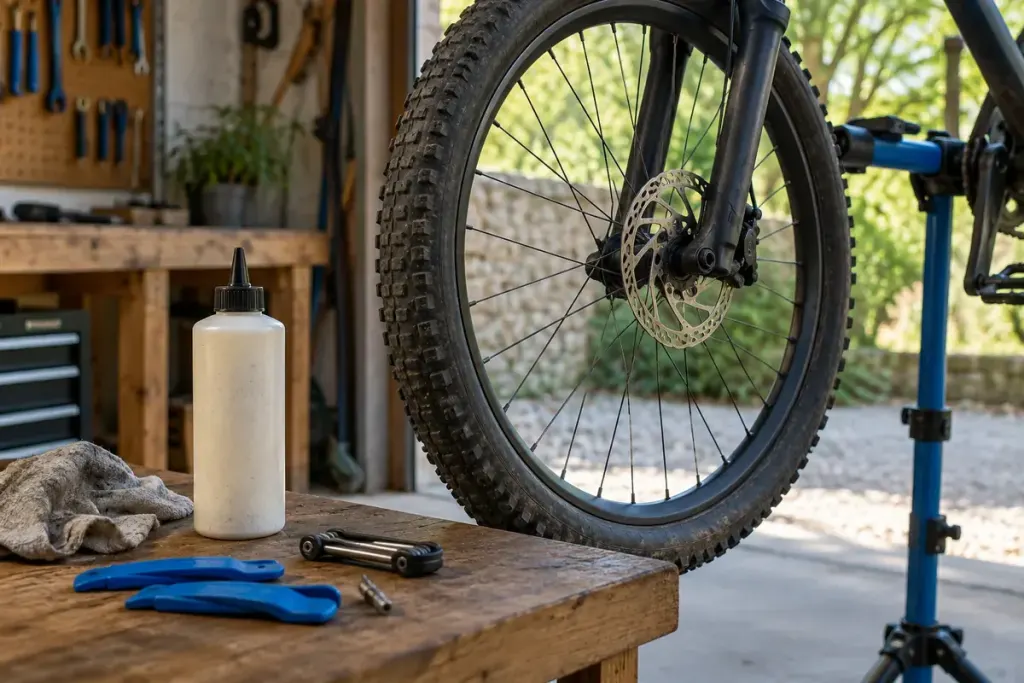
A tubeless tyre can hold air while the sealant inside is no longer ready to deal with the next small puncture. Air retention today and useful liquid sealant tomorrow are related, but they are not the same check.
Schwalbe’s tubeless FAQ explains that its sealant has a limited active life and that conditions affect renewal. The figures given for a particular product are not a universal timetable for every sealant, tyre size or climate.
Before topping up, identify the tyre, rim system and sealant. If a workshop fitted the setup, ask what it used. An unlabelled bottle left in the garage is not a reliable match simply because the liquid looks similar.
Check the manufacturers’ compatibility and quantity instructions. Some products have restrictions concerning mixing, valves, inserts or inflation methods. Follow the instructions for the actual combination rather than importing a friend’s mountain-bike quantity into a much narrower tyre.
Record the product, wheel, date and quantity used, together with the next inspection point recommended for that setup. Add any unusual pressure loss or repeated puncture trouble. This gives a mechanic a clearer starting point than “I added some sealant a while ago.”
If you are unfamiliar with safely deflating, opening and reseating the tyre, have a competent bicycle workshop do the work. A tubeless system can involve substantial pressure, and a bead that appears close to seated is not necessarily correctly seated.
Do not keep adding liquid to compensate for a damaged tyre, poorly seated bead or other mechanical problem. Sealant has limits; a large cut is not made safe by a generous refill. Schwalbe also stresses observing the tyre and rim pressure limits, including the lower limit when they differ.
For the next ride, use the normal pre-ride tyre check and carry a repair plan appropriate to your route. A dated sealant check improves preparation, but it does not promise that every puncture will seal or remove the need to inspect a damaged tyre.