
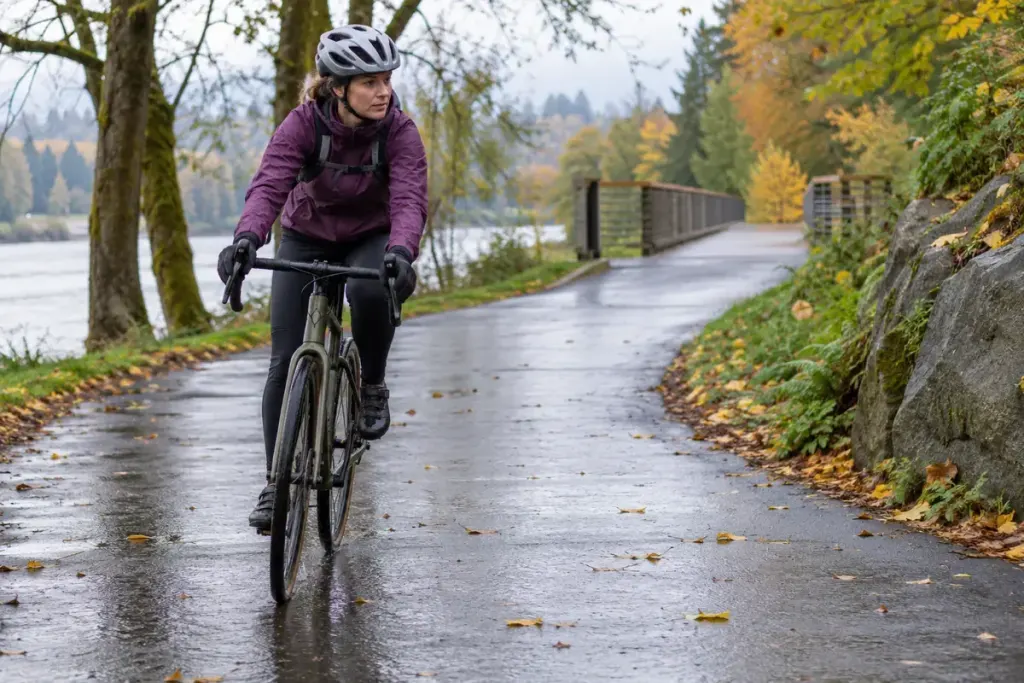
The descent is familiar, but today its surface is wet. Using yesterday’s braking point ignores two things that may have changed: how the brakes respond and how much grip the tyres have.
Cycling UK’s guide to cycle brakes describes how water and dirt on a rim can affect rim-brake performance, while disc brakes generally provide more consistent wet-weather braking. That does not make a wet road behave like a dry one. Brake power and tyre grip are separate limits.
Give the approach more room
Reduce speed before the point at which you need a sharp change of direction. Look further ahead for junctions, pedestrians and surface changes, and leave more space from the rider in front. Avoid treating a successful stop on one part of a route as proof that the next painted marking or metal cover will offer the same grip.
Brake smoothly using the technique appropriate to your bicycle and conditions. If you are unsure of control or equipment condition, get instruction or mechanical help rather than experimenting at traffic speed.
Notice what feels different
A brief, controlled check in a safe area can tell you whether the brakes respond as expected before the journey becomes demanding. If a lever pulls unusually far, braking is inconsistent, or something sounds or feels wrong, stop and have it checked. Do not compensate indefinitely by squeezing harder.
For a practical ride note, record the conditions, brake type and the specific symptom. “Wet front brake took longer to respond at the first stop” gives a mechanic more information than “the bike felt bad”. It also prevents a single difficult ride becoming a vague judgement about all wet-weather cycling.
After the ride, follow the component manufacturer’s cleaning and inspection advice. Keep lubricants away from braking surfaces and do not apply a household remedy to squealing pads.
Sometimes the right adjustment is to shorten the route or wait for better conditions. Planning to slow earlier is useful; accepting a journey beyond your current control is not a training requirement.