
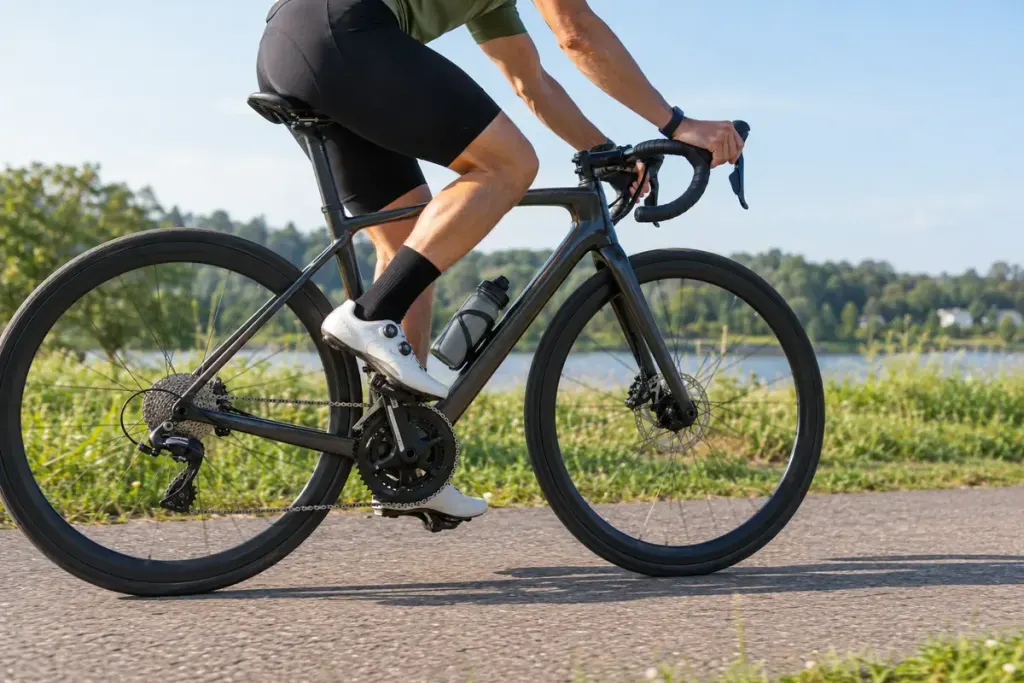
You can pedal quickly while climbing slowly, then travel much faster downhill without turning the cranks. That familiar contrast explains why cycling cadence and road speed need separate labels. Cadence describes pedal revolutions per minute; speed describes how quickly the bicycle covers distance.
Garmin’s sensor documentation identifies cadence in rpm, illustrating the unit used by many cycling devices. The number is not a direct measure of effort, power or fitness. Those require other information and a suitable interpretation.
Put the gear between the two numbers
A gear determines how crank movement relates to wheel movement. Changing gear can therefore change your pedalling rate at a similar road speed. Conditions also matter: a hill, headwind or changing surface can alter the speed you maintain even when the cadence display looks familiar.
Consider a flat, quiet stretch where you can ride comfortably and safely. Without chasing a particular number, notice how a small gear change affects the feeling at the pedals. A harder gear may reduce the number of pedal turns at that speed while increasing the force each turn demands. An easier gear can allow more frequent turns. This is an observation exercise, not a prescription to use an extreme cadence.
Review data after the ride rather than staring at the screen in traffic. If the average looks unexpectedly low, check whether the device includes periods of coasting as zero cadence. Different display or recording settings can make two averages less comparable than they first appear.
For a useful training note, keep route, terrain and the intended session beside the number. Avoid deciding that another rider’s preferred cadence must become yours. Comfort, experience, equipment and the purpose of the ride all influence the choice. If a pedalling pattern causes pain, ease off and seek suitable professional guidance rather than forcing a target from a chart.