
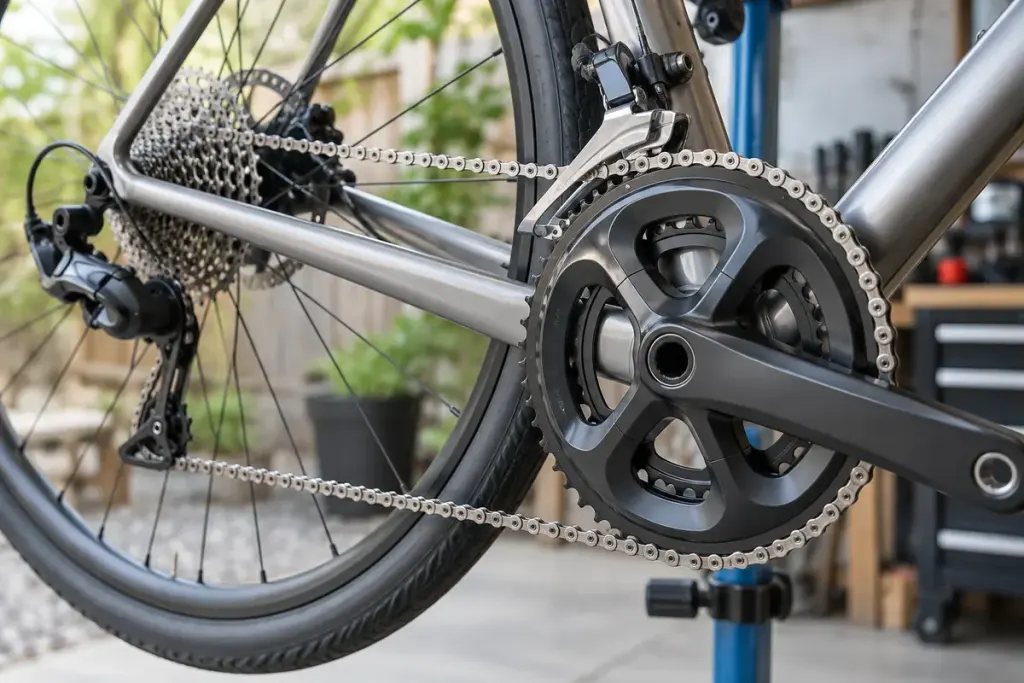
A larger rear sprocket usually makes a derailleur bicycle easier to pedal, while a larger front chainring moves the gearing in the other direction. Counting the teeth turns that familiar experience into a comparison you can calculate.
For a conventional chain-driven derailleur setup, divide the chainring’s tooth count by the selected rear sprocket’s tooth count. The result describes rear-wheel revolutions per crank revolution while the drivetrain is engaged. Internal hub gears introduce another ratio, so the simple calculation is not the whole story for those systems.
Try three combinations
- A 40-tooth chainring with a 20-tooth rear sprocket gives 40 ÷ 20 = 2.
- The same chainring with a 40-tooth sprocket gives 1.
- A 30-tooth chainring with a 15-tooth sprocket gives 2 again.
The first and third combinations share the same basic ratio. They do not necessarily share the same chainline, mechanical compatibility or overall bike setup. Shimano’s guide to one- and two-chainring gravel setups places ratio alongside range and the steps between gears.
A ratio is not a speed
Distance travelled per crank turn also depends on wheel circumference. Speed then depends on how quickly you turn the cranks. Two bicycles with the same tooth-count ratio can therefore travel different distances per turn if their wheels differ.
For your own comparison, write down the easiest and hardest combinations currently available, then note which situation causes difficulty. Struggling on a loaded climb is a different problem from wishing for a smaller step between cruising gears.
Before buying a larger cassette or different chainring, check the manufacturer’s compatibility requirements for the derailleur, chain and other components. Arithmetic can show what a proposed ratio means; it cannot show that the parts will fit or shift correctly. Bring both the calculation and the current component details to a mechanic when the specification is unclear.