
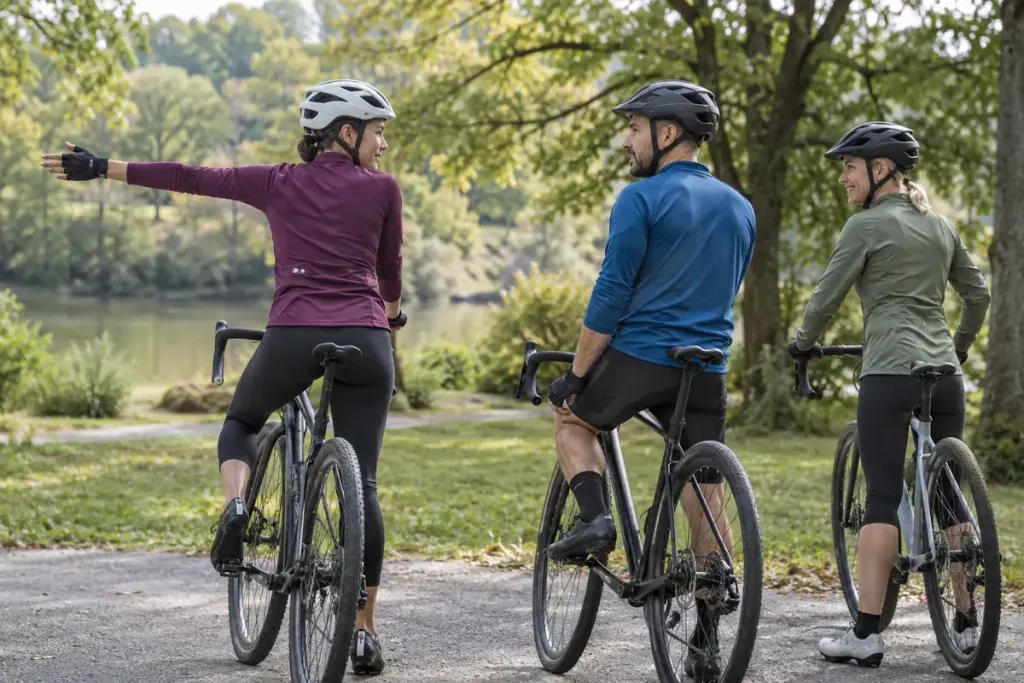
The rider ahead points briefly at the road. You see the gesture but do not know whether it means a pothole, a turn or a request to move. Group riding works better when those meanings are agreed before the wheels start turning.
Cycling UK’s guide to signals and calls describes commonly used UK conventions. Treat it as a reference for that context, then confirm the practice of your actual group and the road rules where you ride. A gesture familiar to one club may be unfamiliar to a visitor.
Use the first minute at the meeting point
Ask the ride leader to demonstrate the signals for slowing, stopping, turning and road hazards. Agree any short spoken calls. Check how information should be passed back through the group without creating a chain of unnecessary shouting.
New riders should be able to ask for clarification without embarrassment. It is much easier to explain a gesture beside a parked bicycle than while approaching a junction.
- Look ahead rather than relying entirely on the person in front.
- Communicate early enough for others to react smoothly.
- Keep control of the bicycle; do not remove a hand when that would be unsafe.
- Use the agreed verbal warning when a hand signal is unsuitable.
Do not swerve towards a hazard simply to point it out. Choose a safe line and allow room for the people following. Likewise, a signal from another rider is information, not permission to cross a junction without checking for yourself.
At the first stop, ask whether everyone understood the calls. If the group is using several words for the same action, simplify the vocabulary. Good communication feels almost uneventful: the group slows predictably, hazards are noticed and riders have time to make their own safe decisions.