
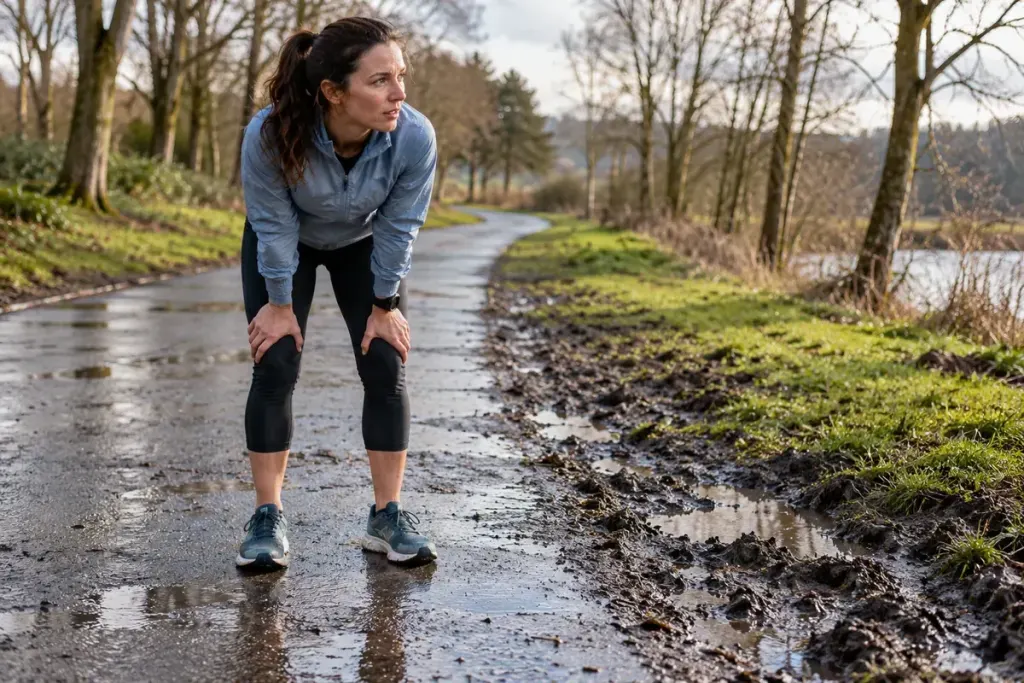
A familiar route can stop being familiar after heavy rain. A paved section may be covered in silt, a short dip may hold standing water and a verge used for passing may have become slippery. Yesterday’s easy loop is not evidence of today’s conditions.
Check the route before committing to the loop
Look for current local weather warnings and path closures. Begin on a section that allows an easy return, and use the first few minutes to observe grip and drainage. This is not a test of how confidently you can run through an uncertain surface.
Standing water can conceal holes or debris. Avoid entering floodwater, and respect barriers even when you cannot see the reason for them. If a safe path is unavailable, choose another route or postpone. Cutting onto a road to bypass a flooded section may introduce a different hazard.
Let the surface change the session
A planned fast workout may become an easy outing on a shorter, reliable route. Do not chase the original pace through slick corners or crowded detours. Leave more space around other path users and slow before uncertain sections rather than braking sharply on them.
For a group run, explain the revised route and turnaround point before setting off. The runner at the back should not discover a route change only after the leaders disappear around a junction.
Afterwards, note the specific problem location and date. “Water across the underpass after overnight rain” is more useful than labelling an entire park unsafe forever. Report a damaged path through the appropriate local channel if you can identify it accurately without approaching the hazard.
Clean and dry footwear according to its care instructions, but do not let equipment maintenance distract from the main lesson. The best decision may have been the shortened route. An easy training day should leave room to return comfortably, not require proving that every planned kilometre was possible.