
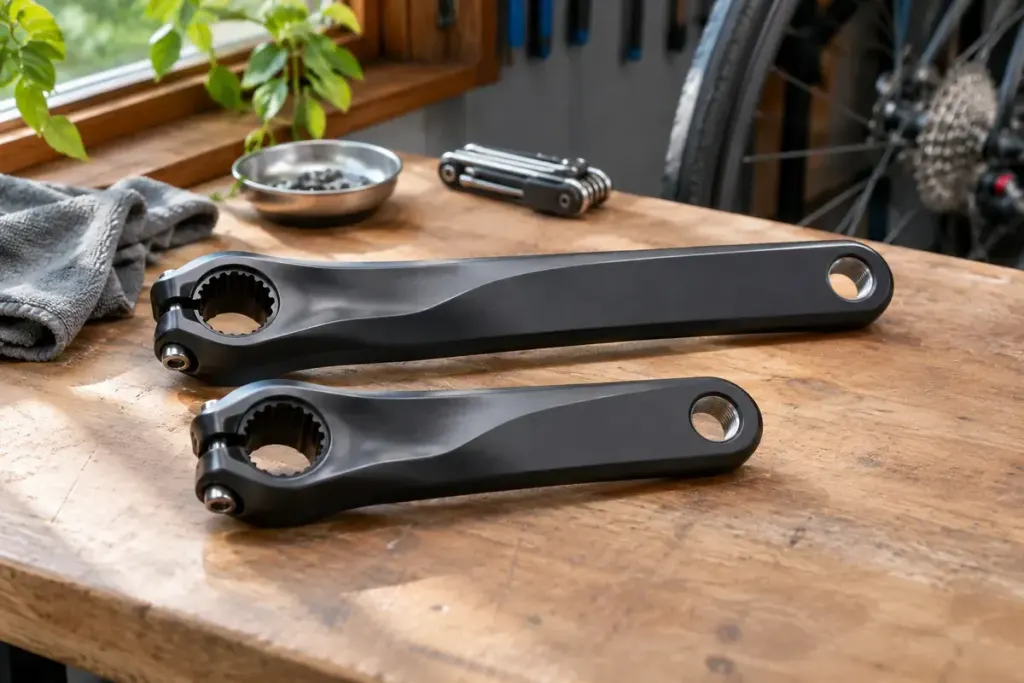
Two crank arms can look almost identical on a workbench while making a noticeable difference to the circle your feet trace. The length is measured from the centre of the bottom-bracket axle to the centre of the pedal axle—not along every visible edge of the arm.
Changing that length is a fit decision. It should begin with a reason related to the rider and bicycle, rather than the assumption that a newer or shorter part is automatically faster.
A smaller circle changes more than clearance
Shimano’s discussion of shorter cranks considers their relationship to hip movement and riding position. Reducing the pedal circle can change the space available at the top of the stroke. It also changes where the pedal reaches at the bottom.
That second point is easy to overlook. Swapping a component while keeping every other measurement untouched does not necessarily preserve the original fit. Saddle position, riding posture, and the rider’s response need to be considered together. There is no useful universal promise that one crank length will eliminate discomfort.
Define the problem before testing a solution
A helpful fit note might say, “I feel crowded at the top of the pedal stroke when riding on the drops.” That is more informative than “I want the crank length used by a professional rider.” It gives a fitter something specific to observe.
If a supervised change is appropriate, compare similar rides and record what changed. Comfort during an easy ten-minute spin does not answer every question about a longer ride, climbing, or a different hand position. Avoid making several unrelated equipment changes at the same time if you want a useful comparison.
Check mechanical compatibility too. A replacement needs to suit the bicycle’s drivetrain and bottom bracket, not merely offer the desired number stamped on its arm. Have installation and tightening carried out to the component manufacturer’s requirements.
The best outcome may be a more comfortable position, or it may be deciding that the current crank is suitable and another adjustment deserves attention. Either is more valuable than buying a part to solve a problem that has not yet been identified.