
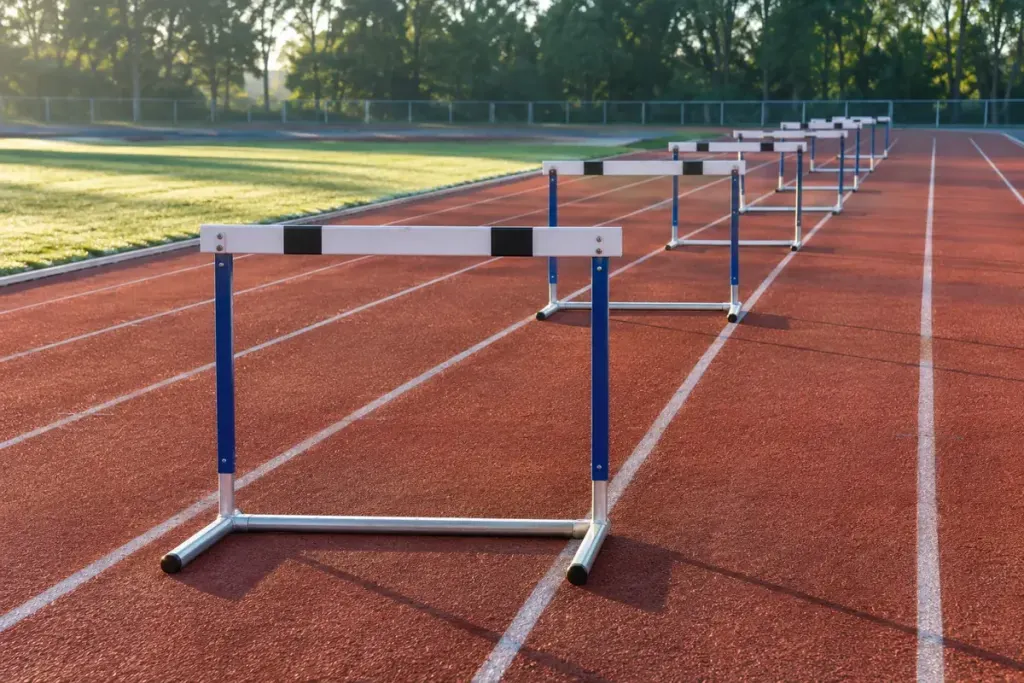
Lowering a hurdle does not turn every race layout into the same training exercise. The distance to the first barrier, the gaps between barriers and the run to the finish all shape the rhythm of the event.
World Athletics lists an 8.5-metre interval for the women’s 100 metres hurdles and a 9.14-metre interval for the men’s 110 metres hurdles. Those examples show why spacing belongs to the event specification, alongside hurdle height and race distance.
Read the layout in three sections
On a race diagram, mark the approach to the first hurdle, the repeated intervals and the final run-in. The repeated gaps are only one part of the total distance. Counting ten barriers does not mean that the entire race consists of ten identical spaces.
When watching a race, notice how the athlete establishes a rhythm before the first barrier and then maintains it between hurdles. A stumble can disrupt more than the clearance itself: the following approach is affected too. This makes the event different from a sequence of isolated standing jumps.
Keep race specifications separate from beginner practice
A developing athlete should not copy an elite competition layout simply because the measurements are available. Age group, ability, event rules and the purpose of the session matter. A qualified coach can select suitable equipment and spacing while teaching approach, clearance and safe progression.
If you are helping set up a supervised session, ask for the exact layout and check which track markings correspond to it. Different events can leave several coloured marks near one another. Guessing from the nearest painted line can create a misleading setup.
For a useful training note, record the coach’s intended exercise, hurdle height, spacing and what the athlete was practising. That makes the next session comparable without assuming that faster running or a taller hurdle is always the appropriate next step.